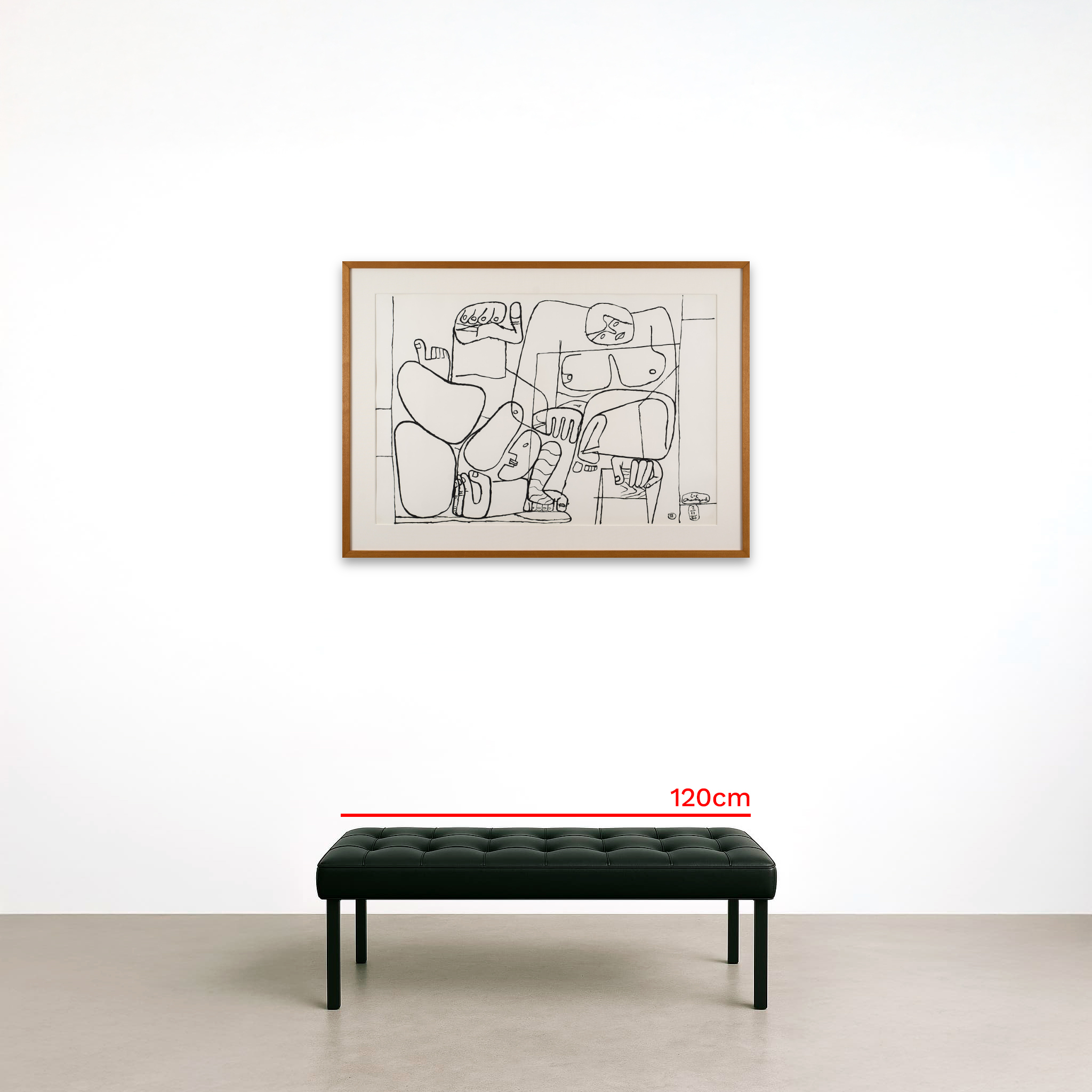
Le Corbusier, a towering figure of modernist architecture, devoted himself to painting throughout his life. The organic motifs enliven the minimal space.
Lithograph 67.7 x 101.3 cm Signed on the plate
Light discoloration across the entire sheet, wrinkles in several places, slight dirt Stains in several places on the back, tape residue along the edges (hidden by the frame)
Overall in good condition
Frame: Chipped upper right corner, scratches in several places, overall in good condition
Weight: 10 kg
Delivery of this piece within Japan will take approximately 1 week to 10 days.
ABOUT Le Corbusier
Le Corbusier (1887–1965) was both an architect and a painter. Before beginning his career in architecture, he was actively engaged in painting. Alongside artist Amédée Ozenfant, he advocated for Purism, a movement that emphasized clarity and simplicity in contrast to the complexity and ornamentation of Cubism. Together, they launched the magazine L Esprit Nouveau (“The New Spirit”) to promote the ideals of modernism.
Purism valued “pure forms” and “ordered composition,” seeking simplicity and precision while still influenced by Cubism. Le Corbusier famously stated that “a house is a machine for living in,” emphasizing the principle that "form should follow function." His designs, stripped of unnecessary elements and optimized for purpose, became a hallmark of modernist architecture.
In painting, “functionality” refers to respecting the intrinsic purpose or use of the depicted object, and creating rational, visually organized compositions. While Cubist artists often deconstructed objects like cups or bottles into fragmented and complex forms, Purist painters depicted them as recognizable shapes within an orderly layout.
Even after achieving worldwide fame as an architect, Le Corbusier continued to paint throughout his life. For him, painting was a vital source of creative energy and a way to clarify his philosophical ideas.
BIOGRAPHY
1887 Born in La Chaux-de-Fonds, Switzerland
1900 Entered the local art school to study watch decoration
1915 Studied in the prints department of the Bibliothèque Nationale (National Library) in Paris
1918 Held the "Purist Exhibition" at Galerie Thomas in Paris with Amédée Ozenfant
1920 Launched the interdisciplinary magazine L Esprit Nouveau (published until 1925)
1929 Designed and built the Villa Savoye
1943 Began research on the Modulor system of proportion
1962 Completed the Palace of Assembly in Chandigarh, India
1965 Resumed studies for the Open Hand Monument in Chandigarh
Passed away while swimming in Cap Martin, France
loading