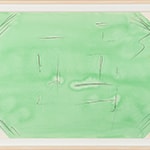
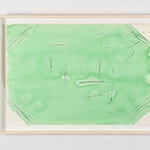
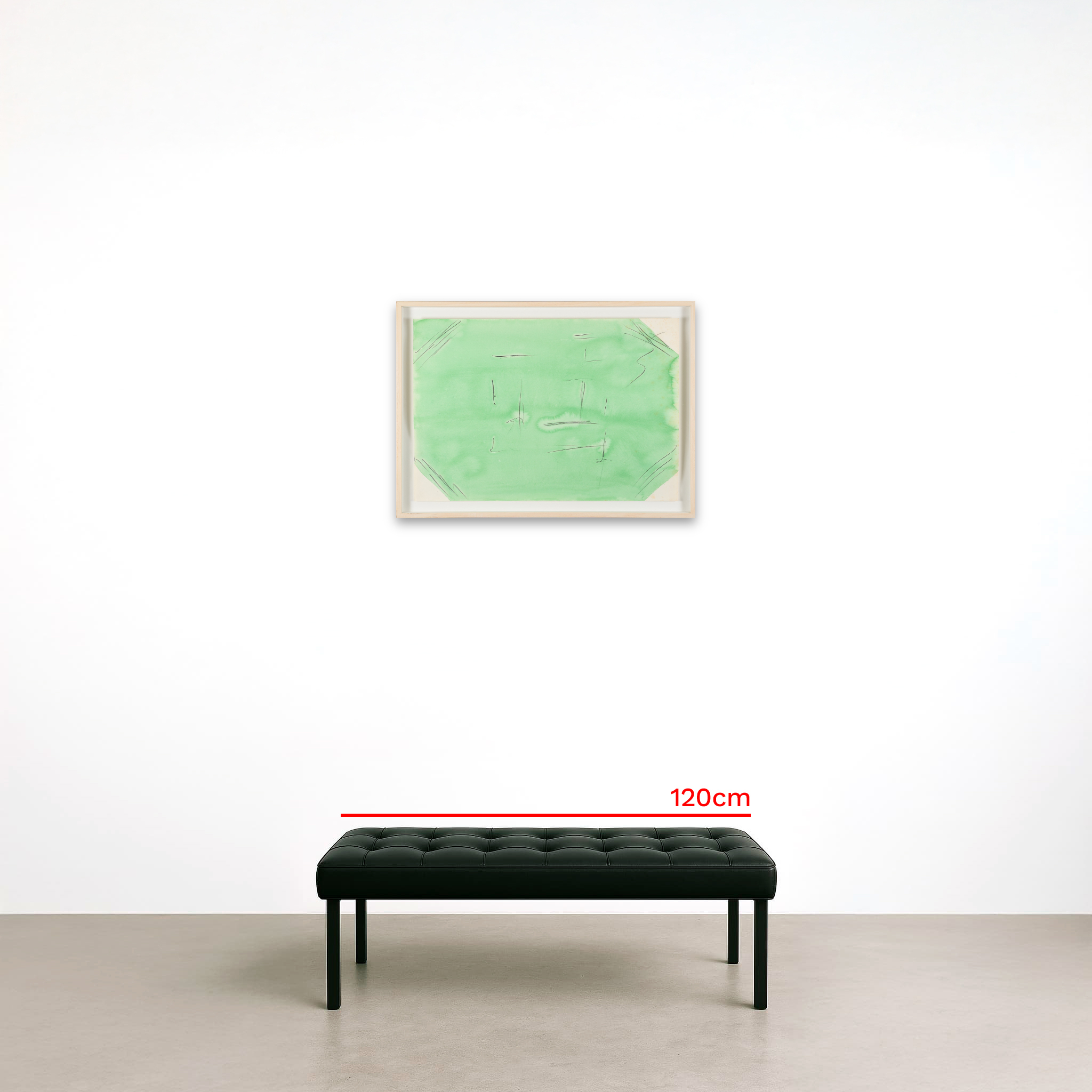
Kishio Suga
To the surroundings = far away
1988
Watercolor and pencil on paper original
54.2×78.8cm
Frame:63.8×88.2cm
- PRICE
- $2,252.25-
- DOMESTIC POSTAGE
- $28.96-
- TAX
- $228.12-
- TOTAL
- $2,509.33-
- Bitcoin Price
- 0.0311BTC
loading
We ship internationally. Please contact us for details.
[If purchasing multiple items] Shipping will be estimated separately.
Payment will be made after receiving the estimate.
Signed, titled, and dated on the back of the paper.
There are light foxing throughout the image, as well as stains and creases in several places.
It is framed, and there is a stain on the lower left side.
Delivery of this piece within Japan will take approximately 1 week to 10 days.
ABOUT Kishio Suga
Kishio Suga was born in Morioka city, Iwate Prefecture in 1944. In 1968 he graduated from the Department of Painting at Tama Art University
Since around 1970, he has been active as one of the central artists of the Mono-ha art movement. Using materials such as stone, iron plates, glass, cotton, paper, wood, and wire, he arranged them in space to construct relationships between [objects and space,] attempting to create [landscapes] that reveal materiality.
During his time at Tama Art University, he encountered Yoshishige Saito, which exposed him to avant-garde artistic expressions that liberated him from traditional art. He also became familiar with contemporary art movements such as performance art and happenings, leading him to explore new modes of expression beyond conventional artistic concepts.
Suga refers to his performances and events as [activations,]which serve as an examination of the connection between [actual creation] and [human agency.] His work revolves around his own actions and the way objects inherently accompany them.
In the context of Western art history, it is often assumed that ideas or concepts precede material objects, which are then created based on those ideas. However, Suga challenged this notion, arguing, [Objects already exist before any image or concept emerges.] He asserted that without a contemplation of the existence and essence of objects, art cannot be born. In other words, he believed that [objects] exist first, and that reflecting on their existence is the true starting point of art.
This philosophy is reflected in his statement:
[People often say they express something, but I hardly ever think about creating art consciously.]
BIOGRAPHY
Kishio Suga was born in Morioka city, Iwate Prefecture in 1944. In 1968 he graduated from the Department of Painting at Tama Art University
【Exhibition】
2021
[20th Anniversary of the Iwate Museum of Art: The Existence of ‘Things’ and the Eternity of Site](Iwate Museum of Art, Morioka, Japan)
2017
[Viva Arte Viva] Curated by Christine Macel, the 57th Venice Biennale, (Venice, Italy)
2016
[Situations](Pirelli HangarBicocca, Milan, Italy)
[Kishio Suga](Dia: Chelsea, New York)
[Karla Black and Kishio Suga] (Scottish National Gallery of Modern Art, Edinburgh, UK)
2015
[Kishio Suga_Situated Latency] (Museum of Contemporary Art Tokyo, Tokyo)
2014
[Kishio Suga](Vangi Sculpture Garden Museum, Nagaizumi, Shizuoka, Japan)
Public Collections
The National Museum of Modern Art (The Centre Pompidou), Paris, FranceTate Modern, London, UK
Dallas Museum of Art, Dallas, TX
Dia Art Foundation, New York
The Museum of Modern Art, New York, USA
Hirshhorn Museum and Sculpture Garden, Washington
M+, Hong Kong, HK
The National Museum of Modern Art, Tokyo, Japan
Museum of Contemporary Art, Tokyo, Japan etc
loading