August Sander
Boxers
1988
gelatin silver print
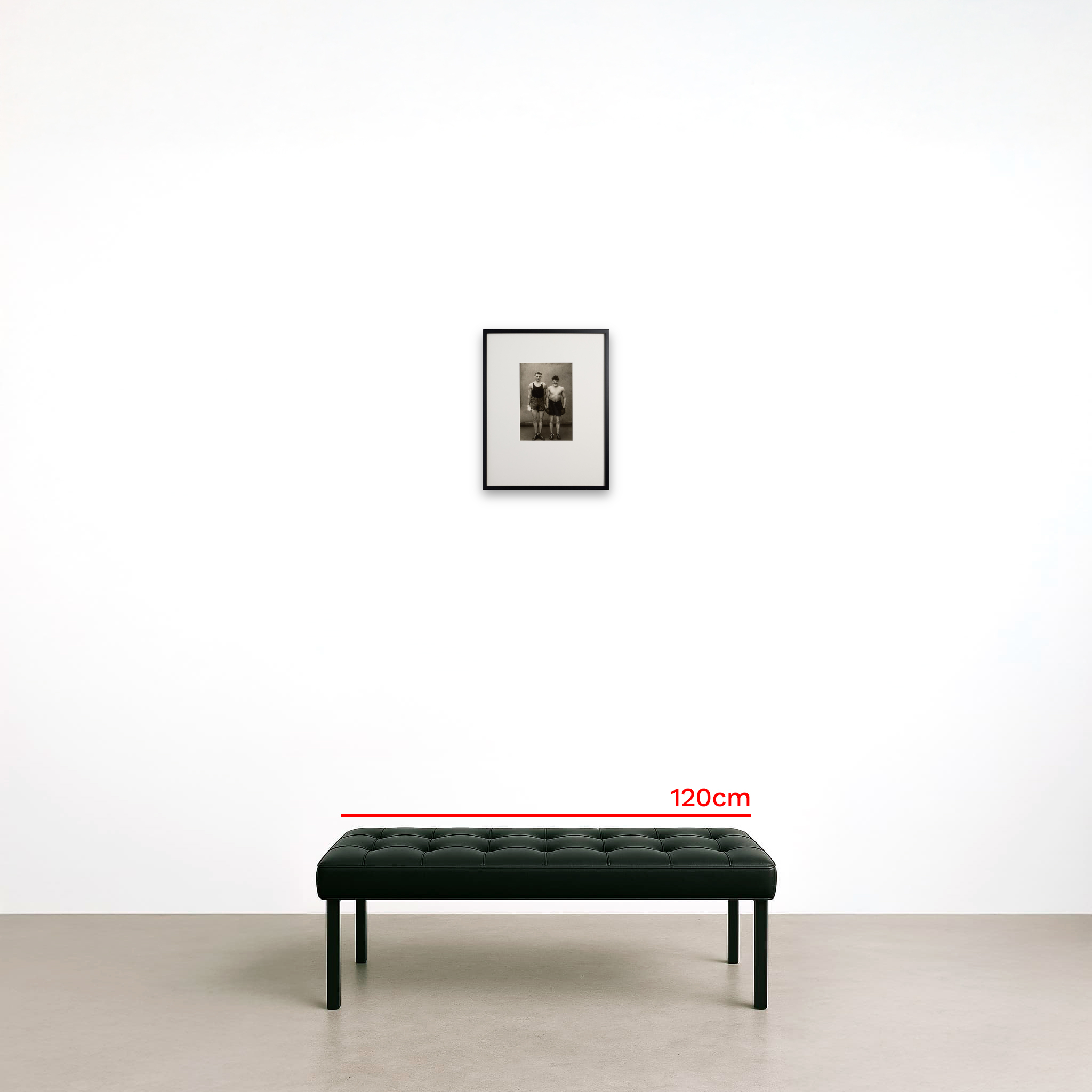
24.5×17.0cm
Frame:43.7×37.3cm
- PRICE
- $2,445.3-
- DOMESTIC POSTAGE
- $19.31-
- TAX
- $246.46-
- TOTAL
- $2,711.07-
- Bitcoin Price
- 0.0342BTC
loading
We ship internationally. Please contact us for details.
[If purchasing multiple items] Shipping will be estimated separately.
Payment will be made after receiving the estimate.
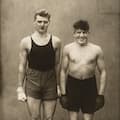
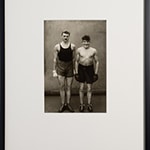
A portrait photograph of two boxers standing. Both have well-defined muscles; one has a scrutinizing gaze while the other is smiling.
Captured by August Sander, these portraits of ordinary people from the Weimar Republic were groundbreaking in the history of photography.
1928, printed by Gerd Sander in 1988 Embossed, signed by Gerd Sander on the back, with an archive label on the mount
Gerd Sander (grandson of August Sander) handled the printing.
Condition: Generally good. Light edge wear, rippling, surface wear, and occasional spotting (restoration marks) are present but overall in good condition. The top of the artwork is directly affixed to the mount.
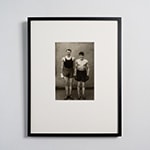
The artwork is framed.
Delivery of this piece within Japan will take approximately 1 week to 10 days.
ABOUT August Sander
August Sander was a prominent portrait photographer who made his living by photographing celebrities and the bourgeoisie in his studio. However, he began an endeavor that was separate from his studio work: he started photographing people whom he considered the so-called petite bourgeoisie, including farmers, "in the open" and "as they are." This marked a revolutionary shift from the conventional portrait photography of the time, which involved photographing "celebrities and the wealthy" in the studio, retouching the images, and presenting them as if they were paintings.
Between 1920 and 1921, Sander decisively abandoned the technique of blurring in photographs to achieve a painterly quality. He was convinced that photography, unlike painting, which inevitably distorts subjects through subjective interpretation and technique, has its own unique value by presenting subjects as they truly are.
The aim of "Menschen des 20. Jahrhunderts" was to create a catalog capturing the structure of society as it was, unembellished by artistic enhancements. However, during Sander′s lifetime, the book was not published.
Sander left the following words about "Menschen des 20. Jahrhunderts":
-------------
Photography can reproduce things with wonderful beauty, but it can also reproduce them with terrifying accuracy, or it can be incredibly deceptive.
As a healthy human being, I hope you will forgive me if I view things not in their ideal or possible forms, but as they actually are. After all, this is all I am capable of.
There is nothing I dislike more than photographs covered in the sugar of pretense, showiness, or affectation. Thus, I wish to present the truth in an honest manner—about our time and about human beings.
-------------
The influence of Sander on German photographers, such as Diane Arbus and the Bechers, was significant.
Reference: "August Sander: Menschen des 20. Jahrhunderts: Portraitphotographien von 1892-1952," Gunter Sander, ed; translated by Tomozo YAMAGUCHI, Libroport, 1991.
BIOGRAPHY
August Sander (1876–1964)
Born in Herdorf, Germany. His father was a mining engineer, but after his health declined, he took up farming. Growing up in a pastoral environment, August became fascinated with drawing the surrounding landscapes. At age 14, he began working in a mine, where he met a visiting photographer documenting the site. By assisting him, Sander learned the basics of photography. With financial help from his uncle, he acquired his own camera and started photographing the mines and local flora.
1901: Began working at a photography studio in Linz, becoming its owner four years later.
1909: Moved to Cologne and established a new studio.
Early 1920s: Joined the Gruppe Progressiver Künstler (Group of Progressive Artists) in Cologne. Around this time, he began working on a grand project: a comprehensive directory of portraits representing people from every profession, social class, and walk of life in Weimar-era Germany to depict the country's social structure. Titled People of the 20th Century, this project was never fully completed or published during his lifetime.
loading