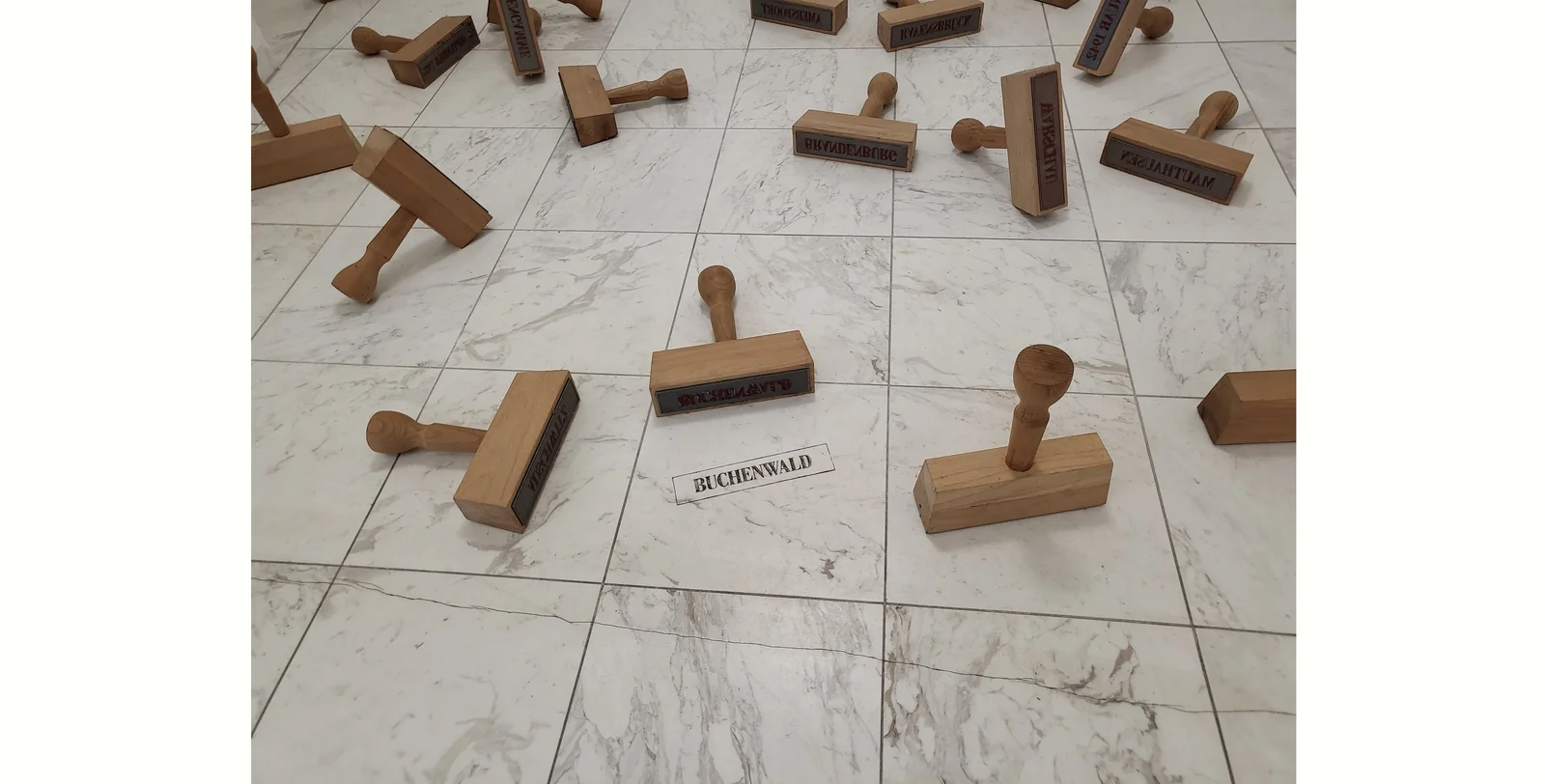
Joseph Beuys Collection of the museum schloss moyland
The world’s longest-running international art exhibition, the Venice Biennale, is facing turbulence. I will omit the details here, but ongoing conflicts around the world are having a major impact behind the scenes. I want to pay close attention to how art confronts war, and how politics influences art.
—————
I think of art as something close at hand, something that can serve as a guide for life. That said, I do not always approach it in such a grand, life-defining way. Most of the time, I simply look at a work and feel delighted thinking, “That’s cool,” or “That’s cute.”
Quite a long time ago, I spoke with someone involved in artistic activities. At a glance, they gave the impression of someone who truly loved fashion. They wore a luxury-brand ring shaped like a circle made from a thorny rose stem. It was such a beautiful ring that I asked about it. They replied, “This ring was expensive for me, but I bought it as a way to constantly remind myself that I had chosen the thorny path of art.” From a cynical perspective, one could say they were simply justifying the purchase of something they wanted but found difficult to afford. Even so, I found this idea of “keeping one’s guiding principles close at hand” deeply appealing.
————
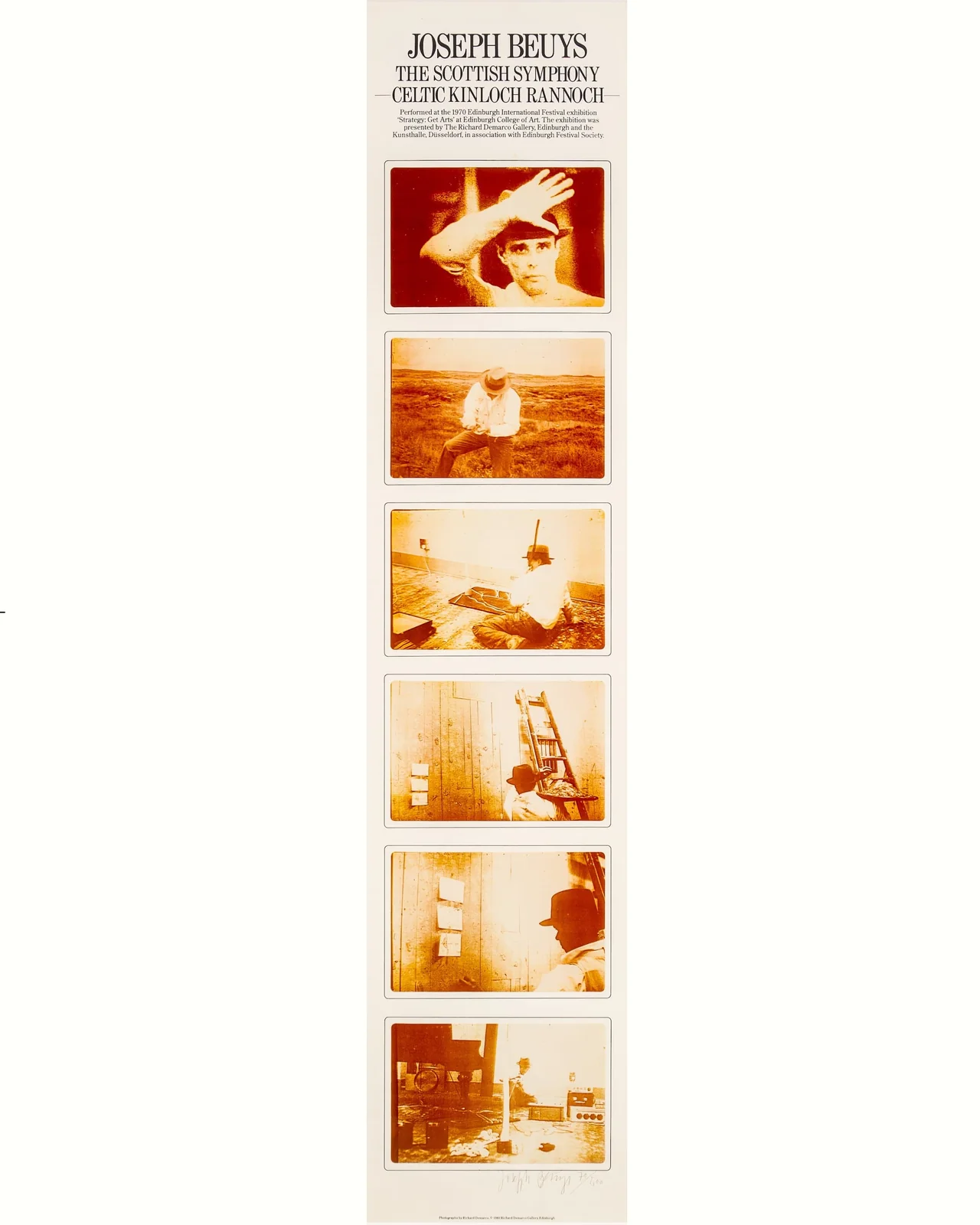
「Scottish Symphony, Celtic Kinloch Rannoch」1980
Now then, one of my favorite artists is Joseph Beuys. Every time I encounter his works, I naturally find myself murmuring, “This is wonderful,” because of the way he interprets materials — that is, the consistency between what he wants to convey and the materials he chooses to express it, with almost no contradiction between them. The intellectual sensibility and dignity embedded in his works make me feel that they are something I would want to keep beside me as a guide for life.
Through sculpture, drawing, performance, and other artistic practices, Beuys sought to expand interpretations of art by applying logical inquiry to specific materials such as fat, beeswax, and felt. He viewed life and society not as fixed entities, but as things in constant flux and transformation, and he proposed the concept of “social sculpture.” “Social sculpture” refers to the free and creative activity aimed at shaping the ideal form of human society. When he said, “Everyone is an artist,” he meant that human beings are inherently creative, and that even those who are not professional artists can express creativity in their own unique ways.
Beuys was always strongly conscious of Europe’s ancestral spiritual culture. In his hometown of Kleve, traces remain of ancient Celtic settlement, and this historical background likely influenced him to no small degree. His performances, known as “actions,” took the form of reconfiguring prearranged groups of objects within shamanistic rituals.
In addition, his experience of being rescued by Crimean Tatars after a plane crash in Crimea during the Second World War profoundly shaped his thinking. Terms such as “spiritual trauma,” “healing,” “substance,” and “transformation” suggest an inclination toward shamanism rooted in those experiences.
The essence of the shaman lies in healing: acting upon qualitative changes in substance while simultaneously serving as a mediator of the spiritual through the body. This quality runs throughout Beuys’s artistic practice as a whole. There must surely have been within him a desire to heal and neutralize the shattered nations, societies, and cities left in the wake of the war.
—————
I feel that war may have had a far greater impact on Beuys than I had previously realized. He rarely addressed war directly in his works. But perhaps it was precisely because he had personally experienced war that he chose not to do so openly. Even so, traces of it lie hidden throughout his works like coded messages.
Just as one senses the presence of God through natural phenomena, Beuys’s enigmatic works say nothing unless we ourselves open our eyes and attempt to read their meaning. They do not loudly assert anything. And precisely because of that, they quietly stay beside us, like guides for living.
*Regarding the materials Beuys frequently used — fat, beeswax, and felt — they can be understood as follows:
Fat changes shape according to temperature: it hardens when cold and melts when heated. Beeswax was regarded as an intermediate substance between blood, muscle, and bone, possessing both heat-retaining and plastic qualities. Felt is not woven, but rather a material created through a combination of artificial and natural elements. Wool, which changes form through beating and compression, contains many of the same important elements found in fat and beeswax within Beuys’s theory of sculpture. Indeed, most of his works exist within processes such as chemical reaction, fermentation, color change, decay, and drying.
References:
JOSEPH BEUYS (Exhibition Catalogue), Fuji Television Gallery, 1993.
Wakae Kanji and Joseph Beuys (Exhibition Catalogue), The Museum of Modern Art, Hayama, 2025-2026.
text:Song Wei
This column is an expanded and edited version of MAIL MAGAZINE 68, originally distributed in our newsletter dated February 28, 2024.
To receive our latest newsletters, please register using the link below.
We also share information on newly arrived works and upcoming exhibitions.